All India Govt Jobs 2026 – Latest Vacancies

Introduction
Government jobs in India are very popular because of their security and benefits. In 2026, there will be thousands of vacancies in central and state government departments. If you want a stable career, you must know how to find and apply for these All India Government Jobs 2026. This article is written in very simple English to help every reader understand. We will explain why these jobs matter and how you can stay ahead of others. You will find genuine answers to all your questions: What exams are there? What are the age limits and qualification needed? When will notifications and results come? How to prepare and where to apply? Each section has clear information, tips, and official links. By the end, you will have a complete plan for your government job journey in 2026. Read on to never miss an opportunity!
Types of Government Jobs in 2026
In 2026, government jobs are offered by both central agencies and state governments. These jobs vary by education level and field.
- Central Government Jobs: These include jobs under ministries and departments of the Union Government. Major exams are held by UPSC, SSC, IBPS, RRB, and others (see below). Positions range from administrative officers to clerical staff and technical posts.
- State Government Jobs: Each state has its own recruiting bodies (State Public Service Commissions, police recruitment boards, state teaching boards, etc.). They announce jobs in state administration, police, teaching, and more.
- Defence & Police: Exams like NDA, CDS, and CAPF (AC) lead to jobs in Army, Navy, Air Force, and central police forces. State police also hold separate recruitments.
- Public Sector Units (PSUs): These are government-owned companies (e.g. ONGC, NTPC, BHEL, BSNL). They hire engineers and other graduates, often through GATE or their own exams.
- Banking Exams: Exams by IBPS and SBI fill jobs in nationalized banks for Clerk and Probationary Officer posts.
- Railways: The Railway Recruitment Board (RRB) conducts exams like NTPC (12th and graduate level) and Group D for railway jobs.
Each category has its own eligibility (10th/12th/degree) and exam pattern. Check specific official notifications for details.
Major Recruiting Agencies
Union Public Service Commission (UPSC)
UPSC conducts high-profile exams like Civil Services (IAS, IPS, etc.), NDA/NA, CDS, IES, CSE, etc. The UPSC Civil Services Exam (CSE) 2026 has ~933 vacancies. UPSC notifications appear on upsc.gov.in. The UPSC CSE Prelims 2026 is on 24 May 2026.
Staff Selection Commission (SSC)
SSC conducts exams for Group B and C posts (e.g. CGL, CHSL, CPO, JE, Stenographer). For 2026, SSC is expected to announce ~15,000+ CGL vacancies. SSC CHSL (10+2 level) and other exams will be notified on ssc.gov.in.
Railway Recruitment Board (RRB)
RRB fills jobs in Indian Railways. Major 2026 recruitments:
- RRB NTPC (National Train): For graduates and 12th pass, total 8868 vacancies. Exams are scheduled in March–June 2026.
- RRB Group D (Level 1): For 10th pass positions, RRB announced 22,195 vacancies. Apply by 9 March 2026.
Institute of Banking Personnel Selection (IBPS)
IBPS conducts bank exams for Clerk, PO, and Specialist Officer posts in public sector banks. The IBPS Exam Calendar 2026 is out. For example, IBPS PO XVI Prelims are on 22–23 August 2026 and Mains on 4 Oct 2026. IBPS Clerk XVI Prelims are on 10–11 Oct 2026, Mains on 27 Dec 2026. Vacancies (Clerk, PO) will be announced in their official notification.
Defense Services & Paramilitary
- NDA/NA (I and II): UPSC conducts the National Defence Academy exam twice a year. NDA (I) 2026 exam is on 12 April 2026; NDA (II) 2026 on 13 September 2026.
- CDS (I and II): UPSC conducts Combined Defence Services. CDS 1 exam is on 11 April 2026; CDS 2 on 12 Sep 2026.
- CAPF AC: UPSC CAPF (AC) exam on 19 July 2026 for Central Armed Police Forces Assistant Commandants.
State Public Service Commissions (PSCs)
Each state has its own PSC (like UPPSC, MPPSC, TNPSC, etc.) for state civil services and other posts. State PSC exams (prelims/mains) occur periodically (generally announced on state websites). For example, UPPSC and others hold thousands of vacancies annually. Check each state’s official website for schedules and notifications.
Expected Vacancies and Posts
A summary of major exams and their tentative vacancies in 2026:
| Exam/Agency | Vacancies (Approx.) | Eligibility | Age Limit | Exam Stages |
|---|---|---|---|---|
| UPSC CSE (Civil Services) | ~933 | Graduate | 21–32 yrs | Prelims, Mains, Interview |
| SSC CGL | ~15,000 (est.) | Graduate | 18–32 yrs | Tier1, Tier2 (Mains) |
| SSC CHSL | To be notified | 10+2 | 18–27 yrs | Tier1, Tier2 (Descriptive) |
| RRB NTPC (Grad) | 5,810 | Graduate | 18–33 yrs | CBT-1, CBT-2, Skill Test |
| RRB NTPC (12th) | 3,058 | 12th | 18–30 yrs | CBT-1, CBT-2, Typing Test |
| RRB Group D (Level 1) | 22,195 | 10th | 18–33 yrs (varies) | CBT, Physical Test |
| IBPS PO/Clerk | To be notified | Graduate | 20–28 yrs (Clerk) | Prelims, Mains, Interview |
| IBPS Clerk (CSA) | ~15,701 (2025) | Graduate | 20–28 yrs | Prelims, Mains |
| NDA & NA (I, II) | ~400 (est.) | 12th | 16.5–19.5 yrs | Written exam, SSB Interview |
| CDS (I, II) | 451 | Graduate | 19–24 yrs | Written exam, SSB Interview |
| CAPF AC | To be notified | Graduate | 20–25 yrs | Written exam, Interview |
| State PSCs (various) | Varies by state | 10th/12th/Grad. | 18–40 yrs (varies) | Prelims, Mains, Interview |
| PSUs (via GATE/exams) | Varies | B.E./B.Tech (for engineers) | Up to 28–30 yrs | GATE/Interview or own exam |
Description: The table above shows major 2026 exams, their approximate vacancies, required qualification, age range, and selection stages. These figures are based on past trends and official updates. Actual vacancies will be confirmed in each official notification.
Eligibility and Age Criteria
Government jobs have specific eligibility rules. Generally:
-
Education: Minimum 10th, 12th or graduate degree depending on the exam. For example, SSC CGL and UPSC CSE require any bachelor’s degree, while SSC CHSL requires 10+2. Technical posts (JE, AE) may require engineering diploma/degree. Bank clerks require graduate degree.
-
Age Limits: Each exam sets age limits. Common ranges:
- SSC exams: usually 18–27 or 18–32 (relaxation for reserved categories).
- UPSC Civil Services: 21–32 (for unreserved).
- IBPS Clerk: 20–28 (SC/ST 5 yrs extra).
- Defense exams: NDA up to ~19.5 years, CDS up to 24.
- State jobs: often 18–37/40 with category relaxations.
Always check the official notification for exact criteria and relaxation details. For example, UPSC requires candidates to be born between 2 Aug 1994 and 1 Aug 2005.
Application Process
Applications are almost always online through official portals. Steps include:
- Check Official Notification: Before applying, read the official notification (on UPSC, SSC, RRB, IBPS, etc. websites) for exam details and instructions.
- Registration: Most commissions require a one-time registration (e.g., SSC One or IBPS/RRB registration) and then a login to apply for specific exams.
- Fill Application Form: Enter personal, educational, and contact details carefully. Download/attach required documents as specified.
- Upload Documents: You may need to upload photo, signature, and other certificates. Ensure scans are clear and within size limits.
- Pay Fees: Pay the application fee online (via net banking, debit/credit card) if applicable. Fees often have concessions for SC/ST/PwD/female candidates.
- Submit and Print: Submit the form and take a printout of the confirmation page or e-receipt. Keep the registration number for future reference.
Applications without proper payment or documents are rejected. Always apply before the last date (no deadline extensions are guaranteed).
Selection Process and Exam Stages
Most government exams follow similar stages. Typical selection phases:
- Preliminary Exam (Screening): Objective test (MCQs). Example: SSC CGL Tier-1, UPSC CSE Prelims, IBPS Prelims, NDA/CAPF, RRB NTPC/Group D. Clearing prelims is mandatory for mains.
- Main Exam / Tier-2: Can be objective or descriptive. Example: SSC CGL Tier-2, UPSC CSE Mains (written papers), IBPS Clerk Mains. Marks usually count towards final merit (except UPSC Prelims, which is just qualifying).
- Interview / Personality Test: For officer-level posts (e.g., UPSC CSE, CDS, some PSCs), final stage is an interview by a board. No interview for clerical exams like SSC CGL, IBPS.
- Skill/Typing/Physical Test: Some jobs require additional tests. For example, RRB NTPC has a Typing Test or Skill Test for certain posts; RRB Group D requires a Physical Efficiency Test. Bank jobs have a language test (for clerks sometimes).
- Document Verification (DV): After merit list is prepared, selected candidates undergo DV to check original certificates (education, age, category, etc.).
- Medical Examination: For some positions (especially defense, police, or jobs requiring fitness), a medical test is done before final appointment.
Each exam’s official notification explains the exact stages. For example, the UPSC CSE has Prelims, Mains, and Interview, while IBPS exams have Prelims and Mains.
Syllabus Highlights
While full syllabi are extensive, key subjects are:
- General Studies/GK: Common in SSC, UPSC, IBPS, etc. Includes current affairs, Indian polity, history, geography, economics, basic science.
- English/Comprehension: Tests vocabulary, grammar, reading comprehension (common in SSC, bank exams, etc.).
- Quantitative Aptitude/Maths: Topics up to 10th or 12th level (arithmetic, algebra, geometry) appear in banking and SSC.
- Reasoning/Logical Ability: Non-verbal and verbal reasoning puzzles are standard in many exams.
- Professional/Technical knowledge: For technical posts (like SSC JE or PSU engineers), relevant engineering topics. UPSC CSE Mains also includes optional subjects (your grad discipline or other).
- Language Papers: Many PCS/PSC exams include regional language papers. SSC CGL also had a descriptive English paper.
Always download the revised syllabus from the official site (e.g. UPSC’s “Syllabus and Exam Pattern” page) and use previous year papers to guide preparation.
Preparation Tips
Preparing smartly can boost your chances:
- Make a Study Plan: Allocate daily time for each subject. Include short breaks. Stick to the schedule.
- Focus on NCERTs and Basics: Build strong basics using NCERT books (history, polity, economics) and high-school maths.
- Current Affairs: Read daily newspapers (The Hindu/Indian Express) and monthly magazines. Make notes of important events, government schemes, and facts.
- Practice Previous Papers: Solve past years’ questions for understanding exam pattern and difficulty level. Time yourself on practice tests.
- Join Test Series: Take regular mock tests and quizzes. Analyze wrong answers to improve.
- Revision: Allocate time for revision of notes and key formulas. Revision is critical in the last few weeks.
- Stay Healthy: Get enough sleep and exercise. A fit mind and body help with exam stress.
Avoid cramming at the last minute. Consistency is more effective. Start early (at least 6–12 months ahead) for tough exams like UPSC.
Admit Cards and Exam Day
After application, admit cards are released typically 1–3 weeks before the exam.
- Download Admit Card: Visit the official website (e.g. UPSC, SSC, RRB) and enter your registration/roll number. Print a copy.
- Check Details: Verify your name, photo, exam date, time, center, and subjects. Report any error to the exam body immediately.
- What to Carry: Carry 1–2 printed admit cards, valid photo ID (Aadhaar, Voter ID, Passport, etc.), and passport-size photo (as mentioned). No other items (mobile, calculator, etc.) allowed.
- Exam Day Tips: Reach the center well before time. Follow instructions, fill OMR carefully, and manage time per section. Positive marking applies in most objective exams (SSC, IBPS, UPSC Prelims).
Answer Keys, Results & Cut-offs
- Answer Keys: After the exam, many commissions release provisional answer keys on their site (e.g. SSC, IBPS, RRB). Use them to estimate your score. There is often a period to challenge wrong answers (by paying a fee).
- Results: Official results (merit list or individual marks) are announced on the commission’s site. For example, RRB NTPC results or SSC CGL results are posted on the respective regional SSC sites. Use your roll number to check. Always download the result PDF when available.
- Cut-off Marks: Cut-offs are minimum qualifying marks. They vary by category (UR, OBC, SC/ST, etc.) and by exam. Usually, the commission will publish category-wise cut-offs along with the result. For example, SSC CGL Tier-1 had cut-offs around 120–140 for General category in recent years.
- Document Verification: After final results, qualified candidates undergo document verification. You will be called to a centre to present original certificates (education, age, category, domicile). Keep extra photocopies ready. Failing DV usually leads to disqualification.
Monitor official websites and Employment News for result dates and cut-offs. Some result updates may also be available on the official Commission’s portal (e.g. upsc.gov.in’s “Active Examinations” section for ongoing exams).
Document Verification
Once you clear all exam stages, the last formal step is verification of your documents:
- Original Certificates: Carry original Mark sheets, Degree/12th certificate, Birth certificate, caste certificate (if applicable), domicile certificate, and any other certificate mentioned in the notification.
- Printouts: Take printouts of your application form, fee receipts, and any admit cards.
- Police Verification (for some jobs): For sensitive posts or certain states, a local police verification may occur.
- Medical Exam: Defense (NDA/CDS/PSC) and police posts often require a medical checkup for fitness.
Once cleared, you will receive appointment orders. Failing document verification (e.g. discrepancies in certificates) leads to removal from the list.
Salary and Benefits
Government jobs offer attractive pay and perks:
- Pay Scales: Entry salaries typically start from Pay Level 4 (approx ₹25,500–81,100) to Level 7 (approx ₹44,900–1,42,400) and above. For example, SSC CGL posts fall in Level 4–7. UPSC IAS starts at Level 10 (~₹56,100) plus allowances.
- Allowances: Cities and rural allowances, travel allowances, and other perks add to basic pay.
- Pension: Central and most state jobs have defined pension schemes or NPS (New Pension Scheme).
- Other Benefits: Subsidized housing, medical facilities, loans, leave travel concessions, job transfers, and leaves make the package attractive.
- Promotion: Structured promotions and increments at regular intervals.
Even at entry, total CTC (including allowances) can be quite good compared to many private jobs, especially for those with family responsibilities.
Pros and Cons
Benefits of Government Jobs:
- Security: Lifetime job security (you are unlikely to be fired).
- Stability: Fixed career growth and annual increments.
- Work-Life Balance: Defined work hours and more holidays (13–18 per year plus public holidays).
- Social Status: Government employees are respected in society.
- Pension and Perks: Post-retirement benefits under pension schemes.
Drawbacks:
- Lower Salary Growth: Private sector can offer faster pay rises, especially in tech/management fields.
- Slow Promotions: Promotions can be time-based and slower in bureaucracy.
- Transfer Posting: You may be transferred across locations (although state jobs are usually within one state).
- Bureaucracy: More paperwork and slower decision-making at times.
- Entrance Competition: Extremely competitive exams require years of study.
Private vs Government:
Private jobs often pay higher salaries initially and have faster promotional paths, but come with job insecurity and no pension. Government jobs offer security and benefits, but sometimes slower career climb. Many aspirants aim for government jobs for long-term stability and societal status.
Comparison Table: Government vs Private Jobs
| Aspect | Government Jobs | Private Jobs |
|---|---|---|
| Job Security | Very high (hard to lose job) | Lower (depends on performance) |
| Salary (Start) | Moderate (with allowances) | Often higher (especially in tech/finance) |
| Promotions | Structured but slow | Performance-based, can be quicker |
| Work Hours | Fixed, 5-6 days/week | Can be longer (flexible, 6 days, odd hours) |
| Benefits | Pension, medical, housing, leaves | Limited (variable by company) |
| Transfer | Yes, possible inter-state/area | Rare |
| Work Pressure | Generally lower (routine work) | Often higher (deadlines, targets) |
| Government Service | Serving nation, respected | Business-driven, customer-focused |
Description: Government jobs offer stability, pay, and perks (pension, leave, etc.). Private sector can pay more and reward performance, but with less security.
Top Preparation Resources
Use only trusted sources for study and updates:
- Official Websites: UPSC (upsc.gov.in), SSC (ssc.gov.in), IBPS (ibps.in), RRB (rrbcdg.gov.in), and state PSC sites. These publish official notifications, syllabus, and admit cards.
- Employment News: The weekly “Employment News” (employmentnews.gov.in) lists central and state job openings.
- Government Portals: GATE (gate.iitb.ac.in for PSUs), CAPF, Police recruitment portals.
- Educational Institutes: Reputed academies like Chanakya, Vajiram, etc., publish guidance (but verify with official info).
- Trusted News Portals: Newspapers/websites (The Hindu, Times of India, etc.) often report major exam dates and results.
- Books and Apps: NCERT books for basics, and standardized test series apps (like Testbook, Gradeup). But always cross-check sample papers with the actual exam syllabus.
Bookmark official pages and subscribe to alert services. Beware of unofficial job scams and sites claiming guaranteed selection.
Timeline of Upcoming Exams (2026)
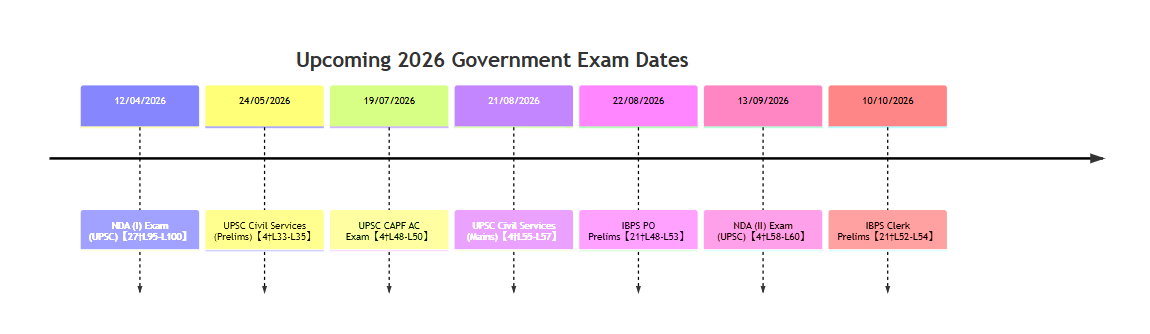
Description: The timeline above shows key 2026 exam dates for major recruitments. NDA (I) is on 12 Apr, UPSC Prelims on 24 May, CAPF on 19 Jul, UPSC Mains on 21 Aug, IBPS PO Prelims on 22 Aug, NDA (II) on 13 Sep, and IBPS Clerk Prelims on 10 Oct.
Common Mistakes to Avoid
- Ignoring the Syllabus: Each exam has a detailed syllabus. Don’t skip any topic.
- Neglecting Current Affairs: Many exams (SSC, bank, UPSC) have significant GK sections. Daily news reading is crucial.
- Poor Time Management: In tests like SSC/Bank, time per question is limited. Practice full-length mocks to improve speed.
- Last-Minute Preparation: Cramming at the end is ineffective. Consistent preparation and regular revision work best.
- Skipping Mock Tests: Mocks reveal weaknesses. Always analyze wrong answers.
- Not Checking Official Updates: Failing to verify dates or changes on official sites can cause missed deadlines or exam day confusion.
Avoid these pitfalls by planning well and staying organized. For example, mark all exam dates on a calendar and verify details on official portals.
FAQ (Frequently Asked Questions)
Q1: What are “All India Government Jobs 2026”?
A: They refer to government job opportunities (central and state) in India for the year 2026. This includes jobs under UPSC, SSC, RRB, IBPS, state PSCs, defense services, and PSUs.
Q2: How do I apply for central government jobs?
A: Applications are usually online on the official website of the recruiting agency (e.g. upsc.gov.in for UPSC, ssc.nic.in for SSC, ibps.in for banking jobs). Fill the form, upload documents, and pay the fee before the deadline.
Q3: Which exams are included in All India Government Jobs?
A: Popular ones include UPSC Civil Services (IAS/IPS), SSC CGL/CHSL, RRB NTPC/Group D, IBPS PO/Clerk, NDA/CDS, CAPF, and state PSC exams. There are also sector-specific exams (e.g. Railway, Bank, PSU).
Q4: What qualifications are needed?
A: That depends on the exam. Some jobs require 10th pass (e.g. RRB Group D), most require 12th pass (e.g. RRB NTPC, SSC CHSL), and many require a bachelor’s degree (e.g. SSC CGL, UPSC CSE, bank exams). Check each notification for details.
Q5: What is the age limit for government jobs?
A: It varies by exam. Generally, 18–27 years for SSC and RRB, 20–28 for banks (clerk), 21–32 for UPSC CSE (General category). Age relaxations apply for OBC/SC/ST/PWD candidates as per rules. Always confirm on the official site.
Q6: Where can I find official notifications?
A: Official notices are on the commission’s website. For example, UPSC publishes on upsc.gov.in, SSC on ssc.nic.in, IBPS on ibps.in, RRB on rrbcdg.gov.in, and each State PSC on its own site. The Employment News portal (employmentnews.gov.in) also lists current openings.
Q7: How often are these exams held?
A: Major exams are usually annual. For example, UPSC CSE once a year, SSC CGL once a year, IBPS bank exams once a year. Some like RRB NTPC may conduct by quota. State PSCs may have annual or bi-annual cycles. Check announcements yearly.
Q8: Are government jobs better than private jobs?
A: It depends on your priorities. Government jobs offer long-term security, pension, and fixed benefits. Private jobs might pay more and grow faster in salary, but with less security. Many candidates choose govt jobs for stability and work-life balance.
Q9: What happens after the exam?
A: Usually answer keys are released to estimate scores. Final results and cut-offs are published later. Shortlisted candidates go through document verification and medical tests before appointment. Keep checking the official website for each step.
Q10: How do I prepare effectively?
A: Make a study schedule, use NCERT books and standard guides for each topic, solve previous years’ papers, and take mock tests. Stay updated on current affairs daily. Joining a coaching class or online study group can help with discipline and guidance.